
Reciprocating pumps are essential assets in industrial operations, especially in oil & gas, chemical processing, and water treatment. However, they are also among the most vibration‑intensive pieces of rotating equipment. Their mechanical motion—characterized by rapid acceleration, deceleration, and pulsation—creates unique vibration signatures that differ significantly from centrifugal pumps.
A midstream operator ran a series of 3‑cylinder reciprocating pumps used for pipeline product transfer. Historically, maintenance relied on:
Manual rounds once per month
Basic pressure and temperature instrumentation
Post‑failure teardown inspections
However, the pumps experienced repeated failures, including:
Crosshead wear
Valve seat cracking
Rod‑load imbalance
Loose foundations
These failures were typically discovered only after a noticeable drop in performance, resulting in expensive downtime.
The plant’s maintenance strategy was based on fixed time intervals for packing replacement. This approach often resulted in:
Premature replacement, increasing maintenance costs.
Unexpected failures, causing environmental and safety risks.
The team needed a predictive method to determine the optimal time for packing replacement.
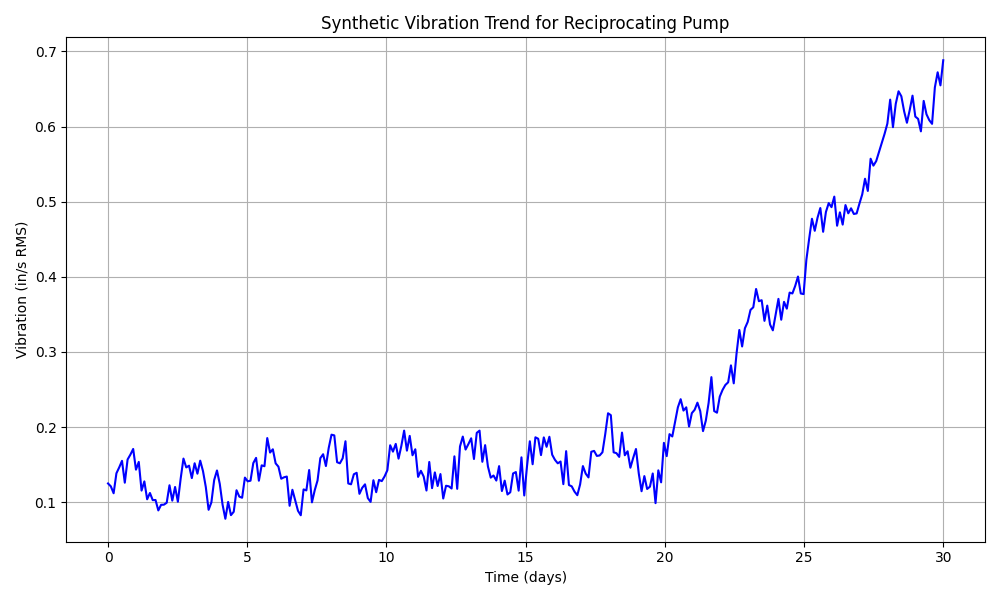
The operator installed rugged, wireless vibration sensors on:
Pump frame
Cylinder head
Crosshead guide
Suction and discharge manifolds
Sensors collected:
Broadband vibration
High-resolution waveform data
Temperature
Pump cycle timing
Impact events (like valve closure pulses)
All data can then be fed into Tenan’s condition-monitoring platform, which uses advanced signal processing tailored for reciprocating machines.
|
Benefit
|
Impact
|
|---|---|
|
Unplanned downtime reduced
|
57% decrease
|
|
Maintenance costs
|
32% reduction
|
|
Pump lifespan
|
Extended by 1–2 years
|
|
Technician efficiency
|
Less manual inspection time
|
|
Reliability across all pump trains
|
Markedly improved
|
Reciprocating pumps create uniquely challenging vibration signatures that traditional monitoring tools often misinterpret. By implementing smart vibration sensors integrated with Tenan’s reciprocating‑pump‑specific analytics, operators can achieve major reliability improvements, avoided expensive failures, and transformed their maintenance strategy from reactive to predictive.
Tenan helps companies make sense of complex vibration patterns—turning high‑noise, high‑pulsation data into actionable insights that protect critical assets.
Signup for to receive updates, product updates and more!